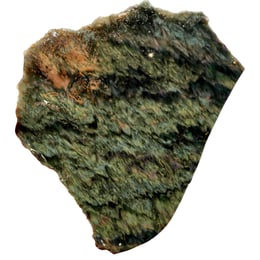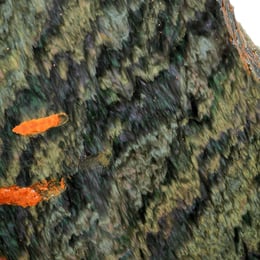
Velvet Obsidian
Physical & Optical Properties
| Family | Mineral |
|---|---|
| Hardness | 5.5 |
| Luster | Vitreous |
| Transparency | Opaque |
| Common Colors | Blue, Black, Green, Purple, Red, Gold |
| Fracture | Conchoidal |
| Origin | Guadalajara region - Jalisco, Mexico |
| Best For | Cabochons, Slabbing, Tumbling, Knapping |
| Difficulty | Advanced |
| Chemical Formula | SiO₂ |
| Specific Gravity | 2.3 to 2.6 g/cm³ |
| Crystal System | Amorphous |
| Refractive Index | 1.5 |

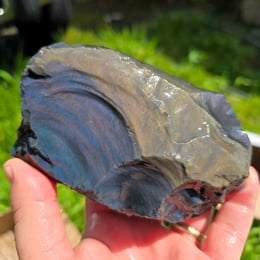
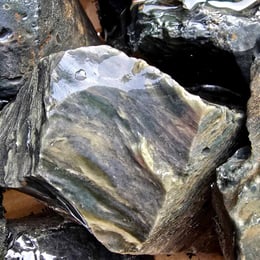
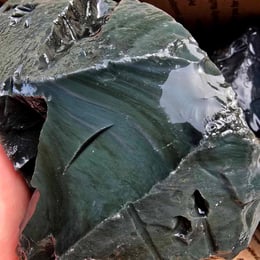
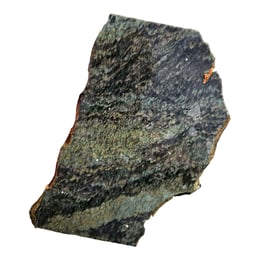
Velvet Obsidian is a rare and highly prized variety of natural volcanic glass found primarily in Jalisco, Mexico, from deposits near Guadalajara. Distinguished from common Rainbow Obsidian by its characteristic folded, swirling and mixed iridescent color play that resembles velvet fabric, this material displays flashes of green, gold, purple, blue, and red against a deep black base when viewed under bright light. It formed from silica-rich lava flows associated with the Trans-Mexican Volcanic Belt, with the color effect caused by microscopic crystals of the mineral hedenbergite embedded in the glass, which split light into spectral colors. Once imported in bulk during the mid-20th century, Velvet Obsidian is now considered increasingly scarce, with the primary deposits largely exhausted and most available material being old stock from the 1960s or earlier, with small amounts being actively mined in present times.
About


Velvet Obsidian is a specific trade variety of obsidian distinguished by its unique optical character. While all colored obsidians from Jalisco share the same volcanic origin, what sets Velvet Obsidian apart is the pattern and quality of its color display. Where Rainbow Obsidian shows distinct, striped or single color bands arranged in parallel layers, Velvet Obsidian's colors appear in folded swirls that resemble crushed velvet fabric. The effect is more diffuse than the sharp, banded iridescence of Rainbow Obsidian, and softer than the metallic flash characteristic of Gold or Silver Sheen Obsidian.
The "velvet" descriptor refers to both the visual texture and the behavior of color within the stone. When rotated and turned under a strong directional light source, colors emerge and shift in soft, undulating waves rather than in crisp lines. This optical phenomenon is caused by oriented nanocrystals of hedenbergite (a calcium-iron mineral in the pyroxene group, with the formula Ca₀.₈₈Mg₀.₀₇Fe₀.₉₈Mn₀.₀₆Si₂.₀₁O₆) or, in some specimens, plagioclase feldspar (a common rock-forming mineral) microcrystals embedded within the glass matrix. These tiny crystal layers create what scientists call thin-film interference light waves bouncing off the top and bottom of each ultra-thin layer either strengthen or cancel each other out, producing different colors depending on the thickness of the layer and the angle you view it from. The swirled rather than banded arrangement of these crystals reflects more turbulent flow during the original volcanic eruption and cooling, as the lava folded over itself rather than flowing in uniform layers.
Some specimens also contain a second rhyolite glass of slightly different composition embedded as lenticular (lens-shaped) areas within the primary glass. The refractive index difference (a measure of how much glass bends light) of approximately 0.04 between these two glass phases contributes to additional interference effects.
Visually, Velvet Obsidian appears as a solid, opaque black stone under normal room light. Its color play is light-sensitive and directional, requiring bright, focused light and rotation to the correct angle to reveal the iridescent swirls. Without optimal lighting, it may appear indistinguishable from plain black obsidian.
The chemical composition of Velvet Obsidian is approximately 70–77 weight percent silicon dioxide (SiO₂, the same compound that makes up quartz and window glass), with smaller amounts of aluminum, sodium, potassium, and iron oxides. Detailed microprobe analysis by Ma et al. (2001) measured the matrix glass at 76.2 wt% SiO₂, 11.6 wt% Al₂O₃, 4.8 wt% Na₂O, 4.4 wt% K₂O, and 2.2 wt% FeO (total).
Locality
Velvet Obsidian is found exclusively in the state of Jalisco in western Mexico, specifically within the greater Guadalajara region. La Revoltosa Mine is the most thoroughly documented active mine producing fine colored obsidian varieties. It is located in San Andrés, Magdalena Municipality, northwestern Jalisco State, approximately 15 km east of the village of San Andrés on Mount San Andreas, roughly 2 km from the Jalisco-Nayarit border, at an elevation of approximately 2,000 meters in a pine forest. Mining is conducted via open-cast extraction (surface mining where rock is removed from an open pit), and blocks weighing many hundreds of kilograms have been recovered.
Jalisco contains an extraordinary concentration of obsidian deposits. Archaeologist Rodrigo Esparza López of the University of Guadalajara has documented 54 obsidian deposits across the state. Geochemical studies have identified 26 or more chemically distinct groups of obsidian in western Mexico. A 2015–2016 geological survey by Canadian geologist Chris Lloyd found that the Ahuisculco area alone contained 69 individual obsidian flows spread over 359 hectares, with Jalisco's deposits ranked as the 4th largest in the world.
Major documented obsidian deposits in Jalisco include El Pedernal (3.5 km northwest of Teuchitlán, covering 4 square kilometers with 217 catalogued ancient mines), La Joya near Magdalena, and Ahuisculco (Selva Negra), covering 300+ hectares of black and red obsidian about 32 km southwest of Guadalajara.
How to Identify
The single most important identifier for Velvet Obsidian is its color pattern. Unlike Rainbow Obsidian, which displays parallel, striped bands of color, Velvet Obsidian shows folded, swirling patterns of diffuse iridescence. A Mindat.org expert further clarifies that in velvet obsidian there are no spectral colors, just a pleasantly fuzzy luster.
Common Imitations
To distinguish real from fake obsidian, several tests can be applied. A translucency test involves shining a strong flashlight through the specimen — real obsidian transmits a faint smoky gray or brownish glow at thin edges. A temperature test confirms that real obsidian feels cool to the touch and takes several seconds to warm. A scratch test shows that genuine obsidian, at hardness 5 to 5.5 on the Mohs scale (a 1–10 ranking of mineral hardness, where 10 is diamond), can be scratched with a steel knife or nail with moderate pressure.
Real obsidian is notably heavy for its size at approximately 2.4 g/cm³, distinguishing it from lighter plastic imitations. In genuine Velvet Obsidian, the color play has depth and appears to come from within the stone, unlike fake rainbow effects that look flat and static like surface coatings.
Lapidary Uses & Tips


Velvet Obsidian is valued primarily for cabochon cutting (shaping and polishing a stone into a smooth, rounded dome without facets), where the curved, polished surface maximizes the display of its swirling color play. It also performs well as tumbled stones, palm stones, pendants, freeform sculptures, slabs, beads, and is suitable for flint knapping (the ancient technique of chipping stone into tools and blades).
The material generally cuts fracture-free and produces clean material for lapidary work. The critical consideration is grain orientation: the stone must be cut with the grain to reveal its color play. Cutting against the grain will not display the characteristic velvet pattern, leaving the result looking like plain black obsidian. This directional requirement makes it not well suited for beginners.
The material takes an excellent, mirror-grade polish. A recommended sanding progression is 400, 600, 1200, then 3000 grit before final polishing with cerium oxide (a fine polishing powder widely used in lapidary work). Extra time should be spent at 1200 grit, as obsidian readily shows fine sanding scratches as a bruising haze that will not polish out. Final polishing is best done on a leather pad at low speed (approximately 600 RPM) with cerium oxide or aluminum oxide compound using moderate pressure. Adding a small amount of vinegar during the polishing stage may improve results by lowering the pH.
Velvet Obsidian tumbles well, and the process removes the outer skin to reveal more of the interior color play. Vibratory tumblers are recommended over rotary tumblers for obsidian. Large amounts of tumbling media is recommended, with less grit and better cleaning than you would do with Agate and Jasper.
Always wear safety glasses when working with obsidian, as it is glass and produces extremely sharp fragments. Wear a protective dust mask and maintain water flow over cutting and grinding surfaces to suppress airborne silica dust, which is hazardous to respiratory health.
Geology
Jalisco sits at the western end of the Trans-Mexican Volcanic Belt (TMVB), an approximately 1,000 km long, 90 to 230 km wide active volcanic chain stretching across central-southern Mexico from the Pacific Ocean to the Gulf of Mexico. This belt was created by the seafloor of the Rivera and Cocos tectonic plates diving beneath the North American Plate along the Middle America Trench, a process geologists call subduction.
Two principal volcanic centers generated the obsidian deposits of the Guadalajara region. Volcán Tequila is an extinct stratovolcano (a tall, steep-sided volcano built up by alternating layers of lava and ash) reaching 2,940 meters altitude. It produced lavas ranging from intermediate to silica-rich compositions over approximately 900,000 years, with its last eruption occurring about 220,000 years ago. Sierra La Primavera is a volcanic complex located immediately west of Guadalajara, active from roughly 145,000 to 30,000 years ago. A massive eruption approximately 95,000 years ago deposited 20 km³ of volcanic ash and created an 11 km wide crater-like depression called a caldera.
Velvet Obsidian formed when silica-rich lava (approximately 76% SiO₂) erupted from volcanic vents along the Tequila-Colli axis and cooled rapidly. This fast cooling prevented crystals from growing, trapping the material as a natural glass instead of a crystalline rock. During flow, microscopic mineral crystals became aligned along flow lines — in Velvet Obsidian, these are nanocrystals of hedenbergite or plagioclase feldspar. The turbulent folding of lava during flow and cooling created the characteristic swirled patterns.
Many popular sources attribute Velvet Obsidian's color to microscopic gas bubbles. The 2001 peer-reviewed study by Ma, Gresh, Rossman, Ulmer, and Vicenzi specifically tested and rejected this hypothesis, demonstrating instead that oriented nanocrystals and dual-glass-phase interference are the true mechanisms.
History
While the trade name "Velvet Obsidian" is a modern designation, the obsidian deposits from which it originates have been used for an extraordinary span of time. The earliest evidence of obsidian use in Jalisco dates back approximately 10,000 years, evidenced by spear points from the Clovis culture (among the earliest known peoples of the Americas) recovered near San Marcos Lake (Lake Chapala).
The Tequila-Colli axis developed into one of the world's greatest ancient obsidian mining zones. The Teuchitlán tradition (c. 350 BCE to 500 CE), the dominant culture of the Jalisco highlands before European contact, controlled more than 1,000 obsidian mines from which an estimated 14,000 tons of obsidian were extracted. The island of Itzlitlán (meaning "Place of Obsidian" in the Nahuatl language of central Mexico) in the former Laguna de Magdalena served as a massive obsidian workshop for 2,000 continuous years.
Jalisco obsidian reached remarkable distances through ancient trade networks. Chemical fingerprinting techniques have traced Jalisco obsidian artifacts as far north as Arizona, where they were used by Anasazi and Hohokam peoples, and into New Mexico, southern Sinaloa, and potentially Guatemala.
The specific variety known as "Velvet Obsidian" entered the modern lapidary market no later than the 1960s, when material was shipped in by the dump truck in large commercial quantities. By approximately the 1980s, the primary deposits had been substantially depleted, and the majority of Velvet Obsidian on the current market is old stock material from pre-1980s extraction.
Cultural Values

The term "Velvet Obsidian" is a modern trade name; pre-Columbian peoples did not distinguish between what we now call velvet, rainbow, or sheen obsidian. The cultural significance discussed here applies to Jalisco obsidian broadly.
Obsidian held profound practical, economic, and spiritual significance across Mesoamerican cultures. In western Mexico, the Teuchitlán tradition built its civilization partly on obsidian wealth. At the ceremonial center of Los Guachimontones near modern Teuchitlán, Jalisco, unique circular stepped pyramids were constructed by a society whose economy was deeply tied to obsidian extraction and trade.
Archaeological excavations of 2,000-year-old shaft tombs in the region have yielded remarkable obsidian craftsmanship: ultrathin obsidian discs approximately three centimeters in diameter but less than two millimeters thick, shaped as round discs and animal or human figures, likely worn as necklaces or sewn onto clothing.
Across Mesoamerica, obsidian served as the material for blades, knives, spear points, scrapers, arrowheads, and the fearsome macahuitl — a meter-long flat wooden sword with obsidian blade segments set into grooves. Highly polished obsidian mirrors were used for fortune-telling and ritual purposes.
The Aztec deity Tezcatlipoca ("Lord of the Smoking Obsidian Mirror") is depicted in codices (hand-painted manuscript books) with an obsidian mirror on his chest, representing gateways between the natural and spiritual worlds. The Nahuatl word for obsidian, itztli, was woven deeply into place names across Mexico. Notably, the word Tequila itself derives from a native term meaning "place where they cut," referring to the ancient obsidian workshops in the area. The Florentine Codex references obsidian medicine (itzpactli), indicating Nahua peoples attributed healing properties to certain obsidian forms.
After the Spanish conquest, indigenous artisans incorporated obsidian into atrial crosses (large stone crosses in church courtyards), blending Catholic and indigenous traditions — Catholic priests viewed the obsidian elements as decoration while indigenous communities maintained them as a continuation of earlier spiritual practice.
The village of Navajas, 30 km southwest of Guadalajara, maintains an active obsidian workshop tradition today, with artisans producing carved sculptures, jewelry, and decorative items from various Jalisco obsidian types.
Related Stones
Shop for Velvet Obsidian and Related Items
See All