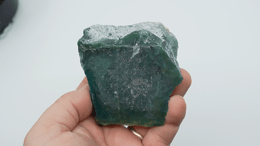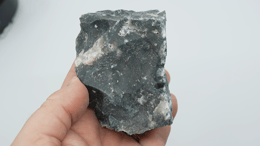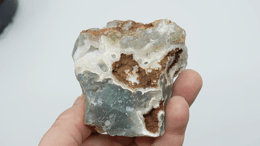
India Tree Moss Agate
Physical & Optical Properties
| Family | Agate |
|---|---|
| Hardness | 7 |
| Luster | Dull |
| Transparency | Translucent |
| Common Colors | Green, Blue, White |
| Fracture | Subconchoidal |
| Origin | Western India |
| Best For | Backlight, Slabs, Cabochons, Beads |
| Difficulty | Beginner |
| Chemical Formula | SiO2 |
| Specific Gravity | 2.6 |


India Tree Moss Agate is a green and white variety of chalcedony, the microcrystalline form of quartz, known for its branch-like inclusions that resemble miniature trees frozen in stone. Like other agates and chalcedonies, it is composed of silicon dioxide and typically measures 6.5 to 7 on the Mohs hardness scale.[2]
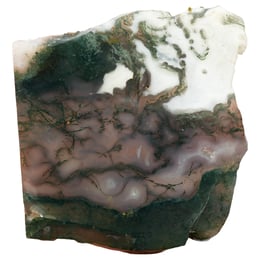
What sets India Tree Moss Agate apart is its dense green dendritic or moss-like patterning against a milky white or translucent background. These inclusions are typically composed of iron or manganese oxides that formed within silica-rich solutions during the stone's development. The result is a stone that looks organic and scenic, making it especially popular for cabochons and carved pieces.
For lapidary artists, India Tree Moss Agate offers consistent hardness, good polish potential, and visually dramatic results with relatively low cutting difficulty.
About

India Tree Moss Agate is technically not a true agate in the strict banded sense. Instead, it falls under chalcedony with dendritic or moss-like inclusions, similar to what mineralogical references classify as moss agate. The defining feature is the internal growth of green, branching inclusions that resemble foliage, roots, or underwater plants.
Unlike dendritic agate, which often shows sharply defined fern-like manganese dendrites, India Tree Moss Agate typically displays softer, more diffuse green formations. The green coloration is commonly attributed to iron-bearing minerals dispersed within the silica matrix. Some pieces lean heavily opaque white with scattered green plumes, while others are more translucent with dense, forest-like scenes.
Locality

India Tree Moss Agate is primarily sourced from western India, particularly the state of Gujarat and surrounding regions associated with the Deccan volcanic province. The Deccan Traps, a massive volcanic formation dating to the late Cretaceous period, are well known for producing agates, jaspers, and other silica-rich nodules within basalt flows.
In these volcanic environments, silica-rich fluids filled cavities and fractures in basalt, later crystallizing into chalcedony. Over time, trace minerals formed dendritic inclusions within the host silica.
While moss agates occur worldwide, including in the United States and Europe, the consistent green and white material commonly sold as India Tree Moss Agate is associated with Indian deposits.
How to Identify

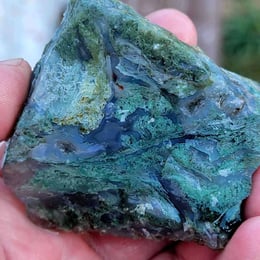
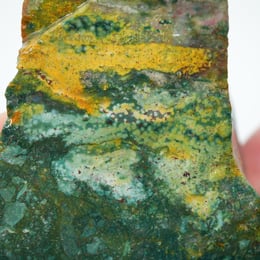
Identification begins with visual inspection. India Tree Moss Agate typically shows green, branching inclusions suspended within a white to translucent chalcedony base. The inclusions appear internal, not surface staining, and often form organic, plant-like structures. When suspended in translucent blue agate, the green moss formations often resemble underwater plants or drifting algae, creating distinct scenic patterns that differentiate this material from other Green Moss Agates.
The stone has a hardness of 6.5 to 7, meaning it will scratch glass and resist scratching by a steel knife. It lacks cleavage and exhibits conchoidal fracture typical of quartz varieties.
Under magnification, the inclusions appear as mineral growths within the silica rather than surface coatings. Compared to dyed materials, natural India Tree Moss Agate usually shows uneven, organic distribution of green coloration rather than uniform saturation.
Lapidary Uses & Tips

India Tree Moss Agate is well suited for cabochons, small carvings, and tumbling. Its quartz-level hardness allows it to take a durable polish while remaining manageable for beginners.
When cutting slabs, pay attention to orientation. Rotating the rough to highlight the most scenic moss patterns can dramatically improve the finished piece. Cutting perpendicular to visible surface patterns often reveals stronger internal scenes.
Use standard silicon carbide or diamond grinding sequences. A progression through 80, 220, 400, and 600, 800 grit, followed by pre-polish and cerium oxide polish, generally produces excellent results. Chalcedony can occasionally undercut around softer inclusions, maintain even pressure and avoid overheating.
History
Moss agate varieties have been known and used for centuries. The name "agate" itself originates from the Achates River in Sicily, where banded chalcedony was described in antiquity. Although India Tree Moss Agate is a modern trade name, chalcedony with dendritic inclusions has long been valued in jewelry and decorative carving.
India has historically been a major center for agate cutting and trade, especially in regions such as Khambhat in Gujarat, which has produced and worked agates for centuries. The combination of local deposits and established lapidary traditions helped popularize Indian moss and tree agates in global markets.
Today, India Tree Moss Agate is widely distributed through gemstone and lapidary supply networks.
Cultural Values
Historically, moss agates have been associated with agriculture and growth. In various cultural traditions, they were believed to promote abundance and connection to nature. These beliefs are part of longstanding folklore rather than scientific claims.
In modern crystal healing traditions, moss agate is often associated with grounding, balance, and new beginnings. India Tree Moss Agate, with its tree-like imagery, is commonly linked symbolically to nature and stability.
Jewelry designers frequently choose this material for its organic aesthetic, which pairs well with rustic or botanical themes.
Geology
India Tree Moss Agate forms within volcanic host rock, particularly basalt flows associated with the Deccan Traps. Silica-rich fluids percolated through vesicles and fractures, gradually depositing microcrystalline quartz.
Dendritic inclusions formed when manganese or iron oxides crystallized within the silica gel before full solidification. These inclusions create branching patterns due to diffusion-controlled mineral growth.
The host material is cryptocrystalline quartz composed of tightly intergrown quartz crystals in the trigonal system.
Treatments
Most India Tree Moss Agate on the market is natural and untreated. However, as with many chalcedonies, dyed materials do exist in the broader agate trade. Artificial color enhancement typically produces unnaturally vivid or evenly distributed green coloration.
Careful inspection for overly uniform color or dye concentrations along fractures can help identify treated material.
Frequently Asked Questions
- India's Gujarat region has been a major agate cutting center for hundreds of years.
- Moss agate inclusions form through mineral diffusion patterns similar to frost crystals.
Related Stones
References
Shop for India Tree Moss Agate and Related Items
See All